Wednesday, March 1, 2023

All New Students...Welcome to the Internal Dynamics of Tai Chi


Ms. E. Marie Koepsell wrote the following article which appeared in Tai Chi Magazine some time ago but I think it speaks volumes about what new students can look forward to in their study. We are also grateful to Rick Matz at Cook Ding's Kitchen for publishing this on a previous occasion. Rick mentions his current training with the Classical Tai Chi DVD's in one of his most recent Blog's...he talks about his training in basic walking using such "Internal Dynamics" (Internal Discipline). Master Stephen Hwa has taken on the difficult but rewarding work that his teacher Young Wabu learned from Wu Chien Chuan. He teaches Classical Tai Chi to hundreds of students worldwide via sets of his great DVD series www.classicaltaichi.com. Teaching primarily at Faust's USA Karate in Rochester, NY, he now teaches in Florida and has certified teachers of Classical Tai Chi in Acton, California, Buffalo, NY, Rochester, California, Colorado and Massachusetts. He is Master Stephen Hwa to his many students since he is truly deserving of the title. 

"The following article is based on the lectures and my studies and discussions with him" (E. Marie Koepsell speaking about Stephen Hwa, Ph.D. when he was teaching Tai Chi at the University of Buffalo). "The internal physical discipline of T'ai Chi Ch'uan" according to Dr. Hwa, "involves the intensive training of the body and mind to develop discipline in movements so that the movements originate from the abdomen (dantien) and back, in addition. the energy flow of these movements are developed in a relaxed body, giving an appearance of effortlessness". As a reference point for correct movement. Dr. Hwa used the example of the movement of children, who use much more of their torso for initiating action. He said when children are using their arms or legs, the motion originates from the torso, the strongest part of the body. He said the arms and legs should he treated as appendages that must be taught to move in coordination with and under the direction of the torso. "As we start aging,” according to Dr. Hwa "less and less of our movements come from the waist and back. We hold our middle stiffly, and more of our movements originate from the shoulders and the hip joints. This puts pressure on joints and we lose strength and mobility. Ultimately, we may stop using these area, of our bodies altogether, Atrophy sets in, creating the major problems of aging.”  

Learning the Internal Dynamics of Tai Chi

Introduction

Although I had studied Tai Chi Ch'uan for a number of years with a few different instructors. I had reached the point where I felt that I could he getting more out of my practice- I did not know what was missing. but I was determined to find out more about the art of T'ai C'hi.

In my quest to understand the art, I attended lectures at the University of Buffalo. which led me to a new realm of understanding. The lecturer, Dr. Stephen Hwa, a retired chemical engineer originally from Wuxi, China. who has been in the (US for 60 years. For 35 years, he was a student of Wabu Young, a student of Wu Chian Chuan

The following article is based on the lectures and my studies and discussions with him.

"The internal physical discipline of T'ai Chi Ch'uan" according to Dr. Hwa, 'involves the intensive training of the body and mind to develop discipline in movements so that the movements originate from the abdomen (dantien) and back, in addition. the energy flow of these movements is developed in a relaxed body, giving an appearance of effortlessness:'


As a reference point for correct movement. Dr. Hwa used the example of the movement of children, who use much more of their torso for initiating action. He said when children are using their arms or legs. the motion originates from the torso. the strongest part of the body. He said the arms and legs should he treated as appendages that must be taught to move in coordination with and under the direction of the torso.


"As we start aging," according to Dr. Hwa "less and less of our movements come from the waist and back. We hold our middle stiffly, and more of our movements originate from the shoulders and the hip joints. This puts pressure on joints and we lose strength and mobility. Ultimately, we may stop using these area, of our bodies altogether. Atrophy sets in, creating the major problems of aging."


He demonstrates this by having students raise their arms to shoulder height and push forward He noted that most people lift and push from the shoulder joint and arm muscle. and there is little strength involved. He demonstrated the way he pushes, using his back and abdominal muscles with the shoulder and arm completely relaxed.  Similarly, When he moved his arm, across his head, his back and abdomen did the work.


Dr. Hwa similarly feels that T'ai Chi steps should involve the muscles of the torso, the large abdominal and pelvic girdle muscles, to lift and push the leg forward and back. He said the leg muscles are used to move the body forward and backward. but the muscles of the torso do the work of lifting and positioning the leg, and planting the foot. The weight shifts after the leading foot is planted solidly on the ground, whether it is going forward or backward.


Turning movements of the body, according to Dr. Hua. are done with the feet stationary and the body swivelling at the waist.  He said it should not be a twisting motion where the hips or legs turn the body. but rather an abdominal movement. When he demonstrates the movement,  his lower and upper abdominal muscles appear to rotate in opposite directions, thus indicating all the power that this movement generates at the waist:


"The unifying principle of the internal physical aspect of T'ai Chi is that all movement and physical energy originate at the waist and back. Those are the strongest parts of the body and its center of gravity as well." Dr. Hwa said.

In discussing the fundamental concept of Yin and Yang. Dr. Hwa said: "In the context of the internal physical aspect. Yang could represent movement while Yin represents the stable structure of the body, against which the movement occurs.”

"Think of a moving door as Yang and the door frame as Yin. The hinge is the junction of Yin and Yang. To achieve internal motion, the primary Junction is always in the torso. It is at these junctions that one senses stretching and the flow of energy. This sensation is called the qi (ch'i)."


"The first goal for the T'ai Chi practitiioner is to have the qi circulate continuously throughout the body, following the Yin/Yang changes of the movements. To achieve the Yin -Yang balance of the body and mind It is essential that these movements of intense energy and stretching be performed in an otherwise relaxed body and mind.”


"The practitioner must not only be aware of the Yin/Yang of individual movements, but also the total Yin/Yang of the body as one goes from movement to movement," Dr. Hwa said.


Learning T'ai Chi, he feels, is more than learning to move smoothly.


"People often admire the smooth-flowing movements of T'ai Chi and that motivates them to start lessons. But one cannot really learn T'ai Chi by just imitating the smooth-flowing movements. One has to start with an isolated movement to learn the Yin and Yang of that movement and then thread the movements together to achieve the effect of continuous motion. The difficulties lie in the first part of that exercise. Once one learns the Yin -Yang, the rest is easier."


In fact, Dr. Hwa said he learned  T'ai Chi as a "square form" first, breaking down the postures into individual, simple moves, preceding and ending each movement with a full stop. When he demonstrates the "square form," it looks discrete, precise and mechanical, completely opposite from the familiar flowing "round form" T' ai Chi movements. The purpose of learning the square form, he explains, is to tame the body, establishing communication and command so that each part of the body can follow a command to move cleanly and effortlessly. This is a foundation for learning internal discipline in the "round form." He also feels that the "square form" provides a template for the "round form" by pinpointing extreme positions of the form movements. It is also very effective flexibility training, loosening many of the key joints essential to the form.


Many students, however, will only learn the "round form." Even with the "round form," he dissects the movements into basic elements for teaching. Many times, he says, a seemingly continuous move is in fact a combination of several distinct moves, merging into each other so that each distinct move becomes almost imperceptible. And yet each has its purpose. The concept of yi, the Chinese word for intention, is also very important in T'ai Chi, Dr. Hwa said.


"It is yi that ties the movements together and provides a purpose and soul to them. Yi is developed based on the knowledge of the form movement, the internal physical and mental discipline and the martial arts origin of T' ai Chi. To integrate this knowledge into a cohesive, singular yi is an essential element in the practice of the T' ai Chi form. The processes of developing the yi and mastering the T' ai Chi form are intertwined. Sometimes the practitioner grasps the essence of yi before one can actually put it into practice. In this case, the yi guides the development of form practice. Sometimes it is the repetition and focus of the form practice that cultivates the yi.


"For the advanced T'ai Chi practitioner, the form itself becomes less expansive externally (so-called "small circle" or "compact form"), and more angular. As such, yi takes on increasing importance in playing the form. There is less movement and more yi. Also, to have smaller external movements and yet reach to all angles in the form requires greater internal movement, more stretching at the Yin- Yang junctions, and more internal energy flow. This is the next level in T' ai Chi."


Dr. Hwa describes the beginning of the T' ai Chi learning process as a highly conscious exercise in which one struggles to move this way and that way and must use the entire mind. But yi is fragmented.


"Gradually, yi becomes more unified, and the movement becomes more fluid. One begins to be able to enjoy some of the qi flow in the body. Eventually, yi and the movements become entirely subconscious. The practitioner is now in a semi-meditative state with only the qi circulating through the body, providing very enjoyable feedback to the practitioner. To achieve this level takes several years of work. But from every step of the journey, very significant benefits will be derived," he said.


I have taken only a few steps on the path of learning, but I am amazed by the richness of the art. My prior T'ai Chi exposure was enveloped in a philosophical and abstract context. But now I see that T'ai Chi can be explained in scientific, concrete terms and it is no longer such a mystery to me. I have developed even more respect and admiration for the art. Unquestionably, the internal physical discipline, with its power to bring out the inherent potential in a person, has been, for me, a most significant discovery.

 E. Marie Koespsell


Tuesday, February 21, 2023

Bruce Lee did not have "superhuman" strength

"Wired" article on Bruce Lee


 Photo is of Stephen Hwa Ph.D. using "Neijin" to fend off 3 people


Regarding the "Wired" link and video, Tom Kostusiak said:  "I came across this. As a physics nerd, I enjoy the explanation. I am curious of the other formulas."

Since Tom "tagged" Stephen Hwa and myself Jim Roach with the Facebook post I decided to pass it on.  I contacted my teacher Tai Chi Master Stephen Hwa and asked him about the "formulas.  

 Stephen Hwa:  "The writer correctly points out Bruce Lee used his body momentum with his punch to deliver the power. The writer calculates his body momentum force with his punching force. So, it is not strictly a Fajing move, if Fajing has to use internal force as I described in my Youtube video, Fajing 1 & 2.."


 Dear Master Stephen Hwa , thank you for the response and deciphering of the writer’s equations. I keep having the thought however that the Physics Professor who wrote the article may have at the very least a lack of caution. How does one not physically see the use of momentum force in these videos? My gosh, Lee’s body (foot) leaves the ground. “A flying body can knock you down” comes to mind in regard to momentum force.


 Calling momentum force “superhuman”? I guess those 12 year olds in my ancient Tae Kwon do class are now "Supermen".  I guess the fascination with Bruce Lee will continue and even color the thinking of even the most educated. This brings to mind what I personally like about your teaching and that is its understanding can be attained at a High School level.

Monday, February 13, 2023

Push hands 1/2 training


1/2 Push Hands Video


Uncovering the Treasure by Stephen Hwa, Ph.D. "Paradoxically and contrary to common belief, practicing the seemingly soft and gentle Compact Form Classical Tai Chi develops internal energy and power while practicing the martial art of push hands and sparring should develop sensitivity and finesse."


My link above is of  Master Hwa and Ike Schultz pushing hands. My suggestion for one and all is to watch, follow and do the movements that just Master Hwa is doing. Of course, I recommend doing this without a partner. That's why I call it Push Hands 1/2.  Just do what he is doing, body, shifting weight, back and forth, extending arms, etc. but minus a partner. You see these back-and-forth movements in the Classical Tai Chi Form in early training of "sit back," "lean forward" and this drill will help. 


I had someone visit my class early at Buffalo State University. He told me he wanted a martial art where he could "kick the butt" of those who disrespected him. I said, "...but what if you get close to them and cannot physically know what they are doing..."   "Also, if you can't know yourself, how can you know them"? 


He looked puzzled, and I said, "...if I put my hand on your shoulder and you don't even sense a light touch, how can you react to a fast, stronger touch..."  I demonstrated the touch on his shoulder,, upper chest, and back. In all three cases, a gentle movement of my hand using a very slow internal motion of my core moved him like a rag doll.   He said, "...that seems like a lot of power; how do you do that..."    I first developed internal strength and power through "Form" and finesse/sensitivity through push hands training with a partner.   I concluded by saying, "...those skills have to develop in that order, "Form" first, then "Push hands".  


To make a martial application, one has to have neuromuscular control. If it is, a punch or a gentle push, one has to "hit the target," not miss, and the same holds for other applications. However, I have seen some gentle push-hands that are painful to watch; because students forget the fundamentals of the Form. 

So you say, "...but I never did push hands before..." I say, "as in the form, so in push hands, as in push hands, so in the form". What you have learned for good or bad rubs off on the other.


Tuesday, February 7, 2023

Video and discussion of “left hand” round form

 Link to video of “left hand” round form 

The Left-Hand Form

"The movements in the I08 Long Form are mostly non-symmetrical in regard to the right and left side of the body. We generally call the normal Form the "right-hand Form". It is purely a name-not necessarily meaning that the right side of the body is more emphasized. Because of the nonsymmetrical nature of the  Form, It results in unbalanced development of the body when one practices this way day in and day out.

When one can play the right-hand Form with ease, it is time to teach oneself to play the mirror image of the Form, so-called "left-hand Form". It is a very beneficial exercise. One can gain considerable insight into ones' Form playing. Students who have gone through this exercise have reported that they sense the weakness on the left-hand Form initially indicating that they have already built up robustness on the right side. Eventually, when one plays the Form, one should alternate between right and left Form to ensure balanced development."


Paraphrase and excerpted from Page100:  Uncovering The Treasure: Classical Tai Chi's Path to Internal Energy & Health Paperback – May 12, 2010


Wednesday, February 1, 2023

"Tuck" is not "frozen rope"


"Pulling the body forward and back."

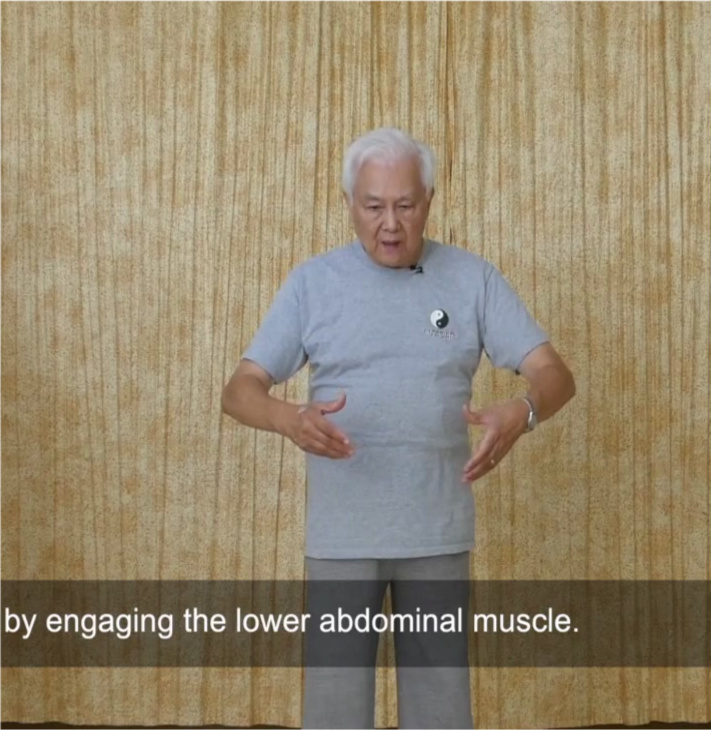
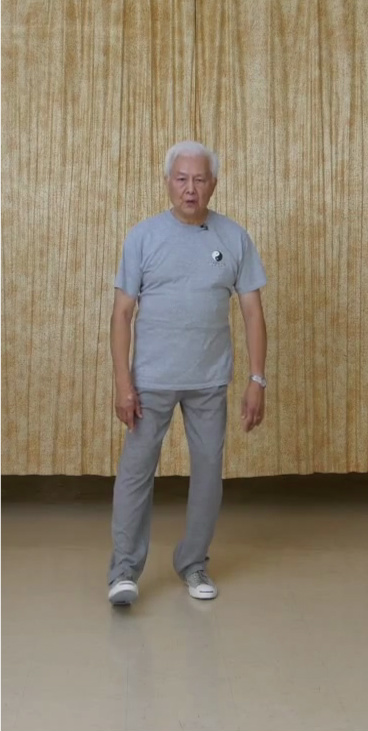
This movement teaches the student or patient how to bring the body forward and backward. These pictures are a segment from a sequence of movements called "Tai Chi Walk." The starting posture, see Picture 1-1, is with the feet parallel at shoulder-width. Now the derriere (buttocks) need to be "tucked in" (euphemistically). It is not a frozen "pelvic tilt"; one needs to stretch the tailbone downward by engaging the lower abdominal muscle.


 Stretch the head using the neck muscle; you want to feel a stretch and tuck in the chin very slightly. Now bend the knee and take a step forward onto the heel of either the right or left foot; see Picture 1-2. Note in Pictures 1-2 that the hips face ahead with the body facing exactly forward. In pictures 1-3, the toe goes down, but the body weight stays on the back foot; this is very important that no body weight "leaks" into the front foot from just putting down the toe. In pictures 1-4, you will pull the body forward using the front foot; note that you do not push with the back foot. 


Using the exact timing as you bend the knee, you "energize" the core (abdominal) muscles and pull the body forward. This "energizing" of the core is a euphemism for a somewhat sharp contraction, a pulling inward of the abdominal muscles below the navel. Pulling the body backward uses the same technique, see Picture 1-5 by pulling with the back foot while you "energize" (sharply contract) the core. One will repeat the pulling back and pulling forward using the core muscles in conjunction with the pull, over and over, forward, back, forward, back, etc. In the forward position, it looks like one is tilting slightly forward; in the backward position, it looks like one is about to sit in a chair. The contraction inward of the core stimulates all the internal organs, the blood flow, and lymphatic flow, becoming a very healthful movement for the internal organs. Another great benefit is stretching the spine by tilting forward and sitting back. When one learns to use the core to energize the movement, it takes much of the workload from the legs, thus relaxing them in the process.


One can Push Hands or do the Classical Tai Chi Form. In either case, one is transitioning between moving forward or sitting back. At a seminar, I heard a student ask: "Is the tuck a pelvic tilt"? The tuck is what is called a pelvic tilt. A while back, Master Hwa started using the term "stretch the back down" to describe what he had called "tuck." Tuck the derriere does require the press in or contraction of the lower abdomen. As a student improves, however, a student can discover that the neural signal to "stretch the back down" will result in an abdominal contraction. 


We have established that the nervous system in Classical Tai Chi learns by discerning the difference between even the smallest of sensations. Therefore, students develop the ability to tell the difference between one sensation and another, first on a macro level, e.g., the difference between the pelvic tilt and stretching down the back, then later, more subtle differentiation. However, a downside can also be an extreme disadvantage with a pelvic tilt. It freezes the ability to turn the waist by making that area static, whereas stretching down the back keeps the ability to turn fluid and dynamic.


Friday, January 27, 2023

Dexterity and strength in the waist


 Jim R: Some time ago, I had a conversation with someone who was an editor at a book company and who is also an author of a book on Tai Chi applications:  I am rewriting as much as I remember from the conversation, and I hope this helps one from what I learned from Master Hwa: A civil conversation about training for Fajin and the "Springs" of recent posts on Youtube, and viewing "A chat with Sifu" by Wynter. 


The editor: "I think I understand what you are proposing; however, I still find the emphasis surprising. I should say that although we talk about the legs generating Jin, it is true that the waist, arms, and hands also do something. They cannot be limp and may even provide substantial energy. One of how I teach as I try to translate my understanding of the classics in simple terms is to say that we should always generate power with the biggest and strongest muscles available and let smaller muscles do supporting work. According to at least some definitions, the muscles controlling the thighs and pelvis are the strongest. They certainly have more range of motion than the muscles controlling the lumbar spine. I would say that the waist can add power to the legs, but not the other way around. I would say that the legs are the heavy springs, and the waist has the medium springs. Once the heavy springs have stored the maximum energy they can, they can share some with the medium springs without loss of collective power; however, if you try to maximize the storage in the medium springs before the heavy ones, you will steal energy from them and limit them." 


Jim R said: 

Hi ,  "What you say makes sense if one takes the giant steps of a large frame. As Master Hwa has said, what we do biomechanically only makes sense in a small frame, a small circle. (I show very small steps of Wu Chien Chuan and Hua Jiping in this Blog)  I have to disagree that legs are the strongest, and they certainly are not possessing the most dexterity coupled with great strength. After all, a great baseball player or tennis player may move the legs and arms to set up the "shot," but the waist, in its turning, gives it the power, the "oomph." 


"I am not talking about large springs, large steps, or large frames as done in Yang, Wu, or Chen styles. The "springs" are weak in the elbow and the shoulder and strong in the waist. There are "reaction" forces to be reckoned with when pushing from the legs. The concept of "firming" the legs inopportunely only serves to negate any relaxation of the legs, much as "firming" up the arm that way as well. Failure to relax arms and legs subjects the body to reaction force which a giant stance may well absorb, but significantly large tai chi stances have many drawbacks. Mobility, Orthogonal forces, double weighting, and more. 


The compact and tight compact Forms use "pulling" with both front and back. The step size is relatively small in a compact form, minimal in a tight compact, and much smaller than what Wu Gong Yi showed in the Gold Book. That pulling is by the "engagement" of contracting (abdominal, back, buttock) core muscles with the legs. The style does not eschew pushing with the legs; it uses it with discretion. For instance, it can use pushing once the opponent's balance is offset. A pushing movement, even with a larger step, can be added opportunely as far as elaborating on the reasoning for "rooted in the feet, generated by the waist, controlled by the legs and manifested through the fingers," as you have talked about in your appreciated books about Tai Chi Classics. 


This statement may apply to certain Large Frame moves which use the leg to generate the pushing force. But, it is not usable in the Compact Form, which produces power from the torso, and it is essential to remember not only the difference in frame size that I speak of here. It is important to remember how equal and opposite force will be sent from the waist down through the pelvis to the leg, finally absorbed by the ground through the foot. During that instant, the buttock and leg will naturally energize to transmit the force to the feet, thus firming the lower body structure to support the fa jin."

Wednesday, January 25, 2023

Controlling movement video


Can Classical Tai Chi Square Form Improve Movement Control? 

It means an unwanted movement that follows uncontrollably after a conscious move. For example, imagine touching and then trying to "stick" to a person's solar plexus with 4 of your fingertips. Still, you end up activating your thumb, which simultaneously makes a fist instead, messing up your "sticking." Remember, you wanted to "follow" the opponent, not hit them with your fist.  


Master Hwa uses the image of sweeping an opponent's leg with yours. If there is another movement in the rest of the body, the sweeping leg loses power as it is drained off. You thought you would "swear" the rest of the body did not move...but it does. The brain needs training on zeroing in the neural signal to ALL junctions.


 Here we have the logical choice of Square Form, where 1000+ movements teach the student to keep integrity in all the Yin/Yang junctions of movement. Yes, the more "robotic", the better because it emphasizes all the small junctions and the large ones of the Yin/Yang pairing. 


The unwanted movement of the thumb is in the brain, not the hand. Master Stephen Hwa's quote: "Most untrained people make moves instinctively...Most beginners cannot keep their neural signals focused on a narrow segment of their body...unintended movement...sloppy movement...".


The unwanted neural activation in the part of the brain that controls the four fingers spreads inappropriately to the amount that holds all fingers and thumb because there is no appropriate inhibition. The hard part of getting better at Classical Tai Chi Form, Sparring, Push hands, or any other form of movement is simply gaining the ability to control unwanted neural activation.


Sunday, January 22, 2023

Happy Lunar New Year


Happy Lunar New Year:  My wish for everyone in the group is to ask themselves the following and to “follow through” on the answers they find in the New Year:


There is no "flowery," "ethereal," or "new age" language in Classical Tai Chi; there is, however, lots to puzzle over and practice. The book, videos, and online learning delineate the routes to solving the puzzle. However, all the student needs is a small place to practice, a desire to enjoy what they do rather than straining to achieve something, some time, and gumption. Here in brevity, is what I might have wanted to know (as a beginner or practitioner) before I start learning.


* What does "internal energy" mean, and what is the way to get it?

* How do all those types of "forms" (large, compact, square, etc.) fit into a learning program?

* What pieces am I missing to learn Tai Chi?

* How does the way I align myself contribute to gaining internal energy?

* Why are there seemingly so many rules to follow when learning this?

* Why does it seem so complex and challenging many times?

* If Tai Chi originated from martial artists, why is it what I see often will look just like dance?

* What in the world can I gain from doing Classical Tai Chi?

* Are there any dangers in doing this? What should I cultivate, and what should I avoid?

* Why does it take so long to learn?

* This art has no "belts" what distinguishes beginners from advanced?


Uncovering The Treasure: Classical Tai Chi's Path to Internal Energy .... https://www.goodreads.com/book/show/13143102-uncovering-the-treasure  as well as being available on Amazon.com for purchase.  Yes, I wrote this in another time to "good reads".

Monday, January 16, 2023

The research is in!

 Link to video of Classical Tai Chi Walking


Here is some research as we learn and "...we learn to walk again..."  I'm going to use Tai Chi Master Stephen Hwa's "coined term," "Ordinary Force,"  and here is some real irony in light of how Tai Chi critics troll Classical Tai Chi Square Form as "ROBOTIC." Understanding how humans walk with my own term, "Ordinary Walk" (which uses "ordinary force"), could help engineers improve walking by developing better human exoskeletons and walking ROBOTS. This is according to research done at a movement lab c/o Ohio State University. 


On his 75th birthday, Master Hwa walked toward me down the school hallway. His walk was Classical Tai Chi extraordinary, not "Ordinary," and each step was accompanied by a corresponding "quarter body move" of the core. This Classical Tai Chi walking is not "ordinary force," and there is no "reaction force" coming back up the legs to "flounder" the body. The legs remain relaxed, with no tension to transfer "reaction force ."We are not Simone Biles floundering that missed step, but we have floundering experiences when we "ordinary walk" daily.   


Simone Biles is not perfect, nor are we. When we walk, our steps are all different. With "ordinary walking," a researcher's mathematical model and data suggest that each step is a tiny fall. There is random-looking variation in our footfalls,  in our steps. We unconsciously do this to get it right, 


  Surprisingly, Scientists have done the math and footsteps related to pelvic positions with "ordinary walk ."When researchers compared this pelvis movement to footfall variations, they found nothing random. It seems pelvic fluctuations can predict more than 80 percent of the side-to-side variation in foot placement. We talk about the "Torso method" in Classical Tai Chi. In everyday walking, however, the torso top tips left, and our effort goes more "leftish" to correct. Torso tips right and stepping further right occurs. How ironic! We diverge to left or right with each walking step, front or back. So these are FALLS, and we fix them with the torso, mainly the pelvis, to control them.


Data shows that following pelvic movement shows where your next step lands better than watching your feet. Your pelvis knows best. They also ruled out other possible influences, like where a person was on a  treadmill belt. The single best explanation for a person's pattern of footfalls was self-correction. 

Whether aware of it or not, each human being is faced with a dilemma in the form of "controlled falling" every time we take a step. The center of gravity is NOT under control, we rely on our subconscious, and we delude ourselves if we think it is conscious walking. 


Some critics say the "square form is robotic," This may be shocking, but stability is not present in their everyday walking, nor is it in yours. Making robots, the scientists said, is about being stable. A robot stops, "it is stable if it does not fall," so it can go very slowly. One must think that the Classical Tai Chi-square form, disposed of as being "robotic," has a creative side. Our walking and controlled falling via momentum have their parallel in the animal kingdom. Ride a horse, however, and sometimes all four hooves are airborne. No slow motion for horses, and it is the same for humans. Our center of mass moves to its highest point in front of the lead foot. So, we begin to fall forward, but our other foot rushes forward to catch us. We then raise our center of mass and "reset" the system for the next step. 


So walking is momentum-based falling and catching (or "controlled falling"), and you are never in a permanent, stable state. Hence the stage is always set for a fall in everyone, both young and old.


Is it any wonder then that we are subject to falling when older? We lose strength in the legs, feeling in the feet, coordination, and more. One has to ask what has happened to the role of the rest of the body in this dilemma. Is the "rest of the body" not the core or torso? In essence, we rely on faulty mechanisms to carry us through an old age that may also be fraught with some disease. 


Master Stephen Hwa says that not every student who starts Tai Chi wishes to become proficient in the art. On the other hand, Classical Tai Chi walking training has many facets. "walking" also tunes the nervous system in the lower body and strengthens it. The essence of "walking" training is to teach the student to use "internal discipline" to direct the movements of the torso to move the legs. The walking training prepares the student how to maintain the correct body posture. Additional elements of the walking training teach the student how to integrate the principles of Tai Chi walking into everyday life.

Monday, January 9, 2023

Straight Lines, Short Distance


Link to Square Form 


Key points on practicing Square Form:


To achieve internal movements, the body must have yin(stationary part) and yang(moving part) paired at the right place. Learning to set the yin-yang pair correctly, the first task is to learn how to set the yin part of the body correctly which is what Square Form trains you to do. That is why Square Form looks robotic-when one part of body moves the other parts of body remain completely still. Therefore, practicing Square Form the more robotic look, the better. If you do not maintain the stillness while other parts of body is moving, the objective of doing Square Form is compromised. You need to know that these yin-yang pairs practiced in the Square Form are imbedded in the Round Form dynamically transforming from one yin-yang pair to another to give the effect of constant motion and continuity.


“This Square Form was taught by Grand Master Wu Chief Chuan to my teacher Young Wabu. At that time, students learning Square Form would not be taught internal, upper quadrant body movements. Therefore, movements using upper quarter body intensively were modified in this Square Form. As a result, this Square form at certain locations is different from the round form.” Master Stephen Hwa

Thursday, January 5, 2023

108 Small Circle Round Form

Video Link Facebook page of Stephen Hwa

YouTube video linkYouTube video link

small frame vs large frame

The difference between small frame (small circle) and large frame tai chi form:

There is saying in China 内传小架,外传大架, "small frame reserved for family insiders; large frame for everyone else."

Small Frame does not mean: just have smaller movements. There are fundamental differences between small and large frame. It is the internal discipline in movements (all movements are carried out from the torso, not from the limbs) resulted in small frame. 

News of Bizarre Wishful Thinking

People often seek shortcuts in internal martial arts, leading to highly unrealistic expectations. In the context of Classical Tai Chi—which ...